Relay
Agents that finish the job.
Field notes
A landing page for an AI agent that isn't purple: ink on warm paper, one orange. The hero is a live tool-call graph where every call leaves a wet-ink trail, tools answer when you click them, and scrolling folds the whole run into a timeline. One raw WebGL2 shader, no three.js.
- WebGL shader
- Scroll-driven
- Pointer interaction
- AI agent
- Light theme
Relay is the site of Quirewright, a fictional agent runtime: a hero, a run log, How it works, a price list and a closing call to action. The hero draws the agent and six tools as a graph on dotted paper. A scripted run sends orange pulses down the edges, sometimes to two tools at once, and each one leaves a ragged ink trail that dries as the next call goes out. Edges lean toward the cursor, and every tool is a real button: click one and the agent pings it, and the answer is typed into the log.
Scroll and the graph folds into a single column in call order, each stop labelled with its call and timing, and a pulse replays the run down it. Below that, four How-it-works drawings ink themselves in, and the pricing is a torn till receipt. Until someone moves the mouse, scrolls or touches the page, the hero plays its own 12-second tour. Your tools, the run and the prices each live in one file, and anyone who prefers reduced motion gets a still graph that still answers clicks.
How it's built
- One full-screen WebGL2 fragment pass draws the paper, the dotted grid, every edge, the pulses and the nodes. Each edge is a quadratic curve cut into 10 straight pieces in JavaScript and sent as a uniform array, so the shader only measures distance to segments.
- The wet-ink trail is per edge: the shader knows how far along the edge each pixel is, lights the stretch just behind the pulse head, roughens its width with a fixed hash and adds a faint stain around it, then the whole trail fades as it dries.
- The run is a pure function of time: heat, trails, pulses and the typed log come from the events of this loop and the last, never from a per-frame decay. Any frame can be drawn on its own, so the recorder can jump straight to it and frame 0 matches frame 12 pixel for pixel.
- Scrolling the sticky stage sets a fold from 0 to 1. Each node slides from the graph layout to one column, curves swap their bow for arcs left of the column, and the DOM labels slide from under the node to its right, where the call and its timing fade in.
- Tool nodes are real buttons laid over the canvas, so clicks, keyboard focus and screen readers work without hit-testing pixels; a click adds a ping event to the same timeline the scripted run uses.
Inside the prompt
Every file below is written out in full, so your agent creates the project exactly — no guessing, no missing pieces.
relay-agent/
├─ .gitignore
├─ index.html
├─ package.json
├─ tsconfig.json
├─ vite.config.ts
└─ src/
   ├─ App.tsx
   ├─ index.css
   ├─ main.tsx
   ├─ vite-env.d.ts
   ├─ components/
   │  ├─ Cta.tsx
   │  ├─ Header.tsx
   │  ├─ HowItWorks.tsx
   │  ├─ Pricing.tsx
   │  └─ Stage.tsx
   └─ lib/
      ├─ graph.ts
      ├─ loop.ts
      ├─ motion.ts
      ├─ run.ts
      ├─ shaders.ts
      └─ timeline.ts
Recut it
- Rename the tools and their run-log labels
src/lib/graph.ts → NODES / EDGES - Rewrite the agent's run and the log lines
src/lib/run.ts → STEPS - Move the graph or the folded column
src/lib/graph.ts → WIDE / TALL / nodeAt() - Change the plans and prices
src/components/Pricing.tsx → PLANS - Rename the product and rewrite the hero
src/components/Stage.tsx → Stage() - Change the colours and fonts
src/index.css + src/lib/shaders.ts → @theme / PAPER, INK, ACCENT - Retime the demo tour
src/lib/timeline.ts → ARRIVE / PING_AT / FOLD_IN / REPLAY_AT
More in Landing Page
All landing page templates →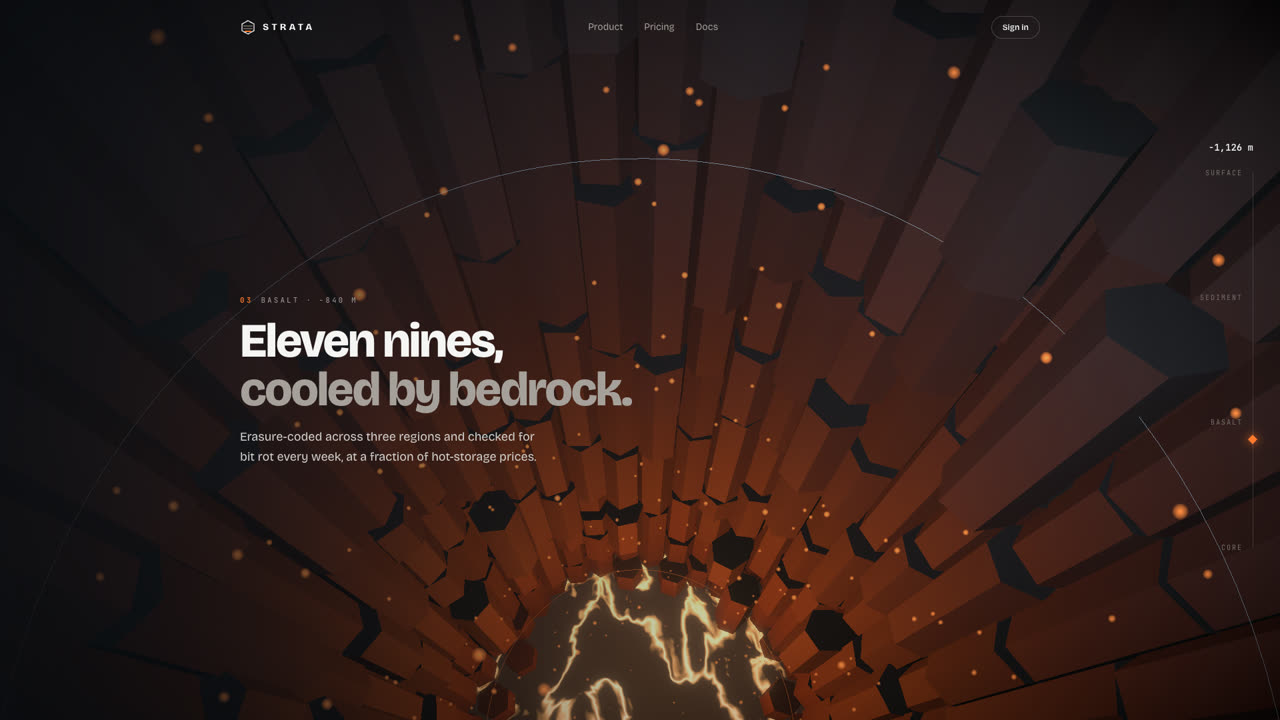
Strata
Landing PageScroll and the camera sinks down a shaft of hexagonal basalt columns, past four chapters, to a molten core. Instanced Three.js prisms, one small lava shader, and a scroll spring: no models, no textures.
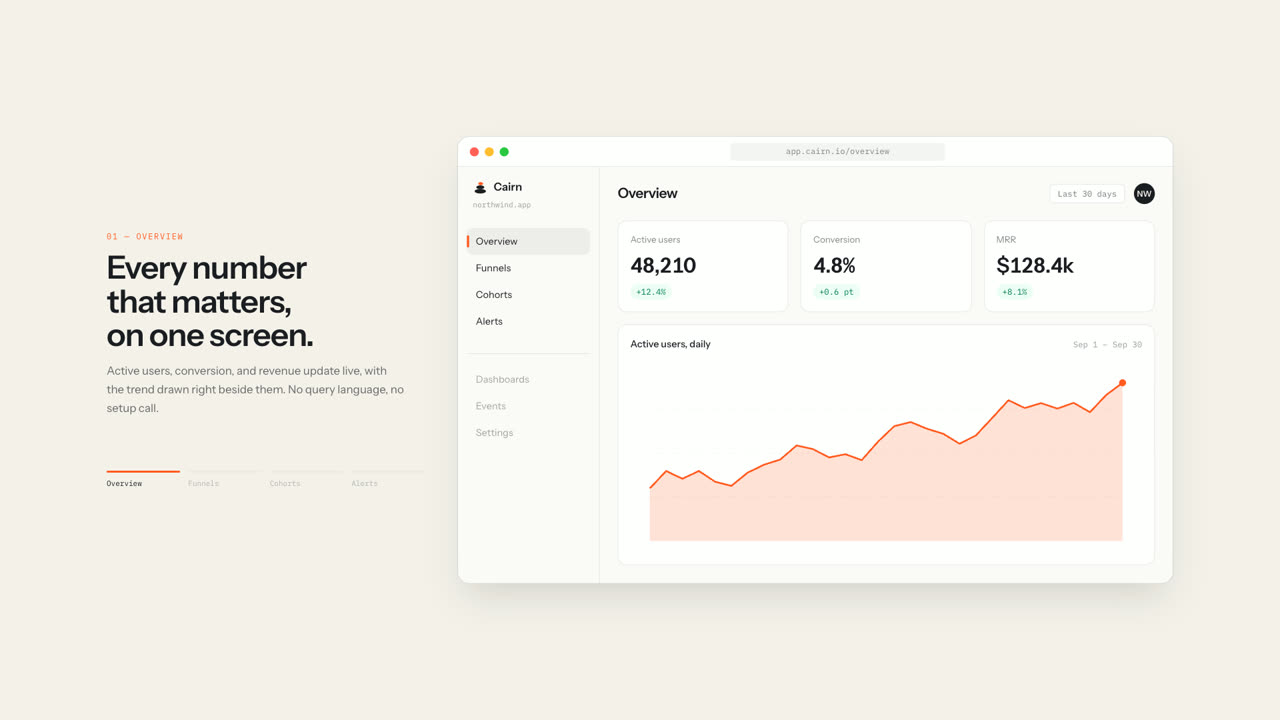
Cairn
Landing PageA complete SaaS landing page where the app window pins in place and changes screens as you scroll: KPIs count up, a funnel grows, a cohort grid fills in, an alert fires. Every chart is hand-built HTML and SVG. No chart library, no images, no WebGL.
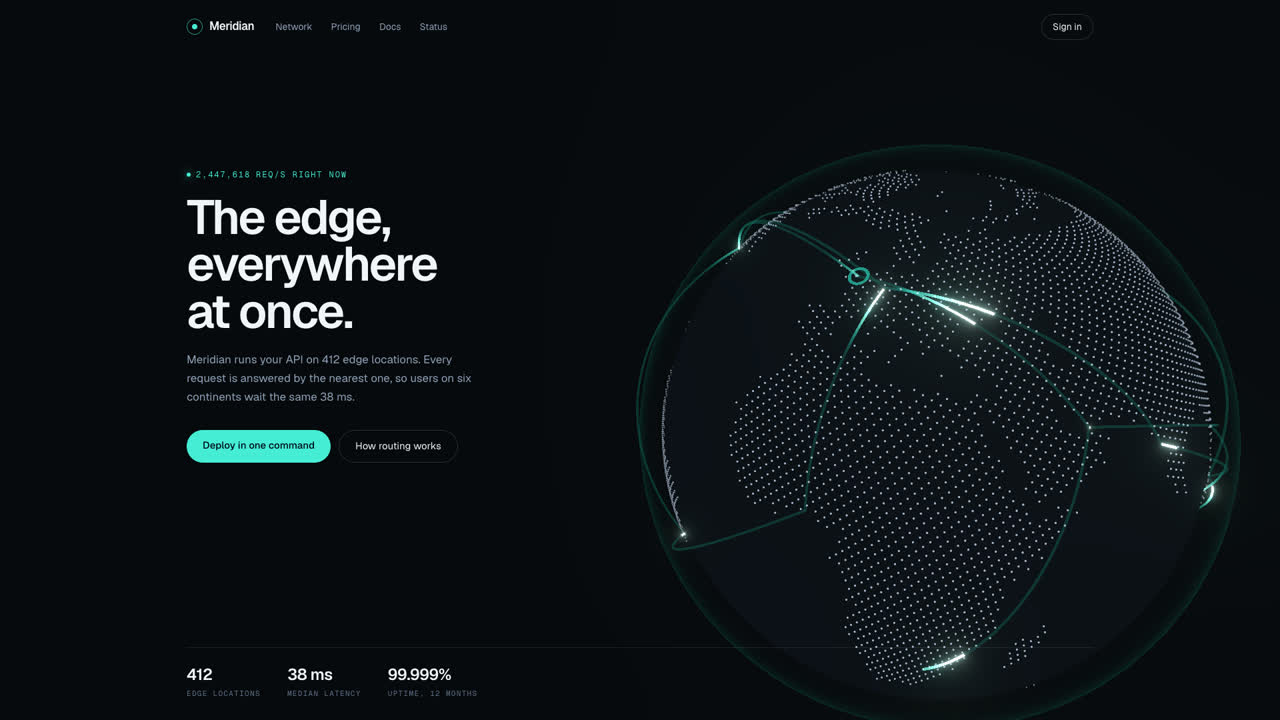
Meridian
Landing PageA dark hero for an API or infra product: a dotted globe drawn from real coastlines, with traffic arcs firing between cities and landing in a ping. Drag to spin it. No models, no textures, no map requests.